

Engineering is often seen as a field of rules, calculations, and precision. But the most powerful engineering ideas do not come from formulas alone. They come from curiosity, experimentation, and the ability to imagine something better than what already exists. That is the heart of creative engineering.
Creative engineering blends technical knowledge with originality. It is the process of solving problems in new, useful, and often surprising ways. Whether it is designing smarter machines, building sustainable systems, or improving everyday products, creative engineers do more than make things work. They make things work better.
In a world that changes quickly, creative engineering has become more important than ever. Businesses need faster innovation, cities need smarter infrastructure, and people expect solutions that are efficient, sustainable, and easy to use. Creative engineering helps turn those expectations into reality.
What Is Creative Engineering?
Creative engineering is the use of engineering principles alongside imagination, design thinking, and innovation to develop solutions that are both practical and original.
It goes beyond following standard methods. Instead, it asks questions like:
- Can this be simpler?
- Can it be safer?
- Can it use less energy?
- Can it serve people in a better way?
- Can we solve this problem from a completely new angle?
A creative engineer does not just accept the first answer. They explore alternatives, test ideas, refine concepts, and connect knowledge from different fields. This approach is valuable in industries such as software, architecture, product design, manufacturing, robotics, and renewable energy.
Why Creative Engineering Matters
Creative engineering is not just about making things look innovative. It has real-world value.
- It leads to better solutions: Traditional methods solve many problems, but creative thinking often uncovers smarter or more efficient approaches. A new design may reduce cost, save time, or improve performance.
- It supports innovation: Innovation rarely happens by accident. It comes from people who are willing to question old methods and create something new. Creative engineering is the foundation of that process.
- It helps solve complex problems: Many modern challenges are too complex for one-discipline thinking. Climate change, transportation, healthcare technology, and digital systems all require inventive solutions that combine logic and creativity.
- It improves user experience: The best products are not only functional. They are also intuitive, comfortable, and enjoyable to use. Creative engineering helps build solutions around human needs.
- It drives progress across industries: From clean energy systems to smart devices and advanced infrastructure, creative engineering pushes industries forward and creates long-term value.
Key Traits of a Creative Engineer
Creative engineering is a mindset as much as a skill set. People who excel in this area often share a few important traits.
- Curiosity: They ask questions, challenge assumptions, and want to understand how things work.
- Problem-solving ability: They can break down complex issues and find practical ways forward.
- Adaptability: They are comfortable with change and open to experimenting with new methods.
- Collaboration: Creative engineering often requires teamwork across different fields such as design, science, coding, and manufacturing.
- Persistence: Not every idea works the first time. Creative engineers keep testing, learning, and improving.
Examples of Creative Engineering in Action
Creative engineering appears in many everyday and high-tech applications.
- Sustainable product design: Engineers are creating products with recycled materials, lower energy use, and longer lifespans. This helps reduce waste and environmental impact.
- Smart technology: From wearable devices to smart home systems, creative engineering makes technology more responsive and user-friendly.
- Transportation innovation: Electric vehicles, improved public transit systems, and safer road infrastructure are all examples of engineering that balances function with forward-thinking design.
- Healthcare solutions: Creative engineering supports medical devices, diagnostic tools, and hospital equipment that improve patient care and accessibility.
- Architecture and construction: Modern buildings increasingly use innovative materials, energy-efficient systems, and modular design to improve performance and sustainability.
The Creative Engineering Process
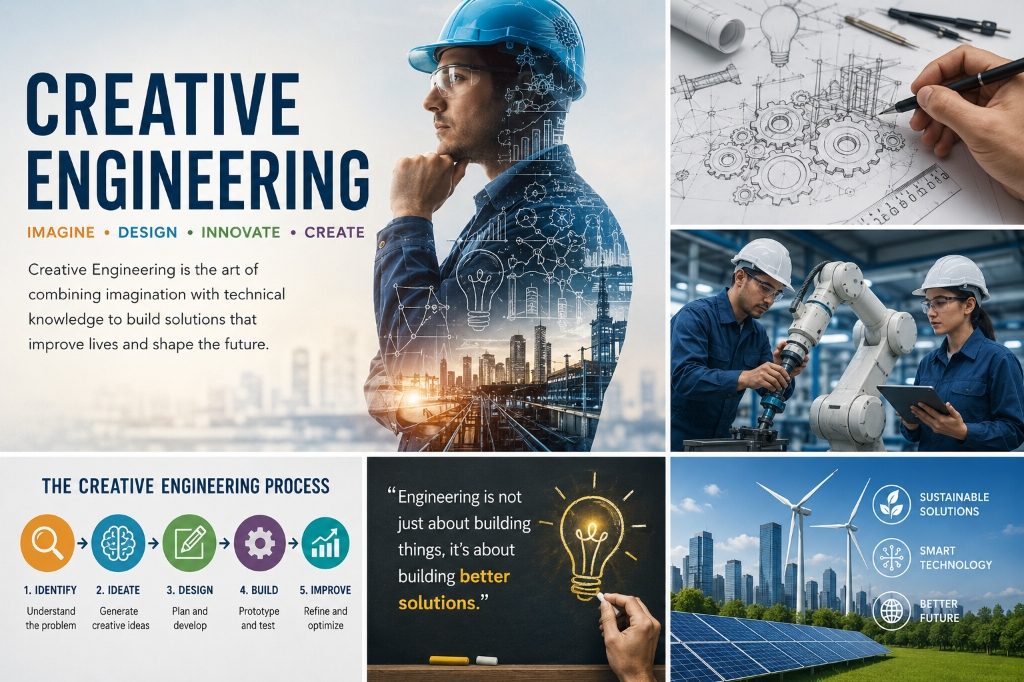
Creative engineering is not random inspiration. It follows a thoughtful process.
- Identify the problem: Every strong solution starts with a clear understanding of the challenge.
- Research and explore: Engineers gather information, study existing methods, and look for gaps or limitations.
- Brainstorm ideas: This is where creativity comes in. Multiple ideas are generated without immediately judging them.
- Prototype and test: Ideas are turned into models, sketches, simulations, or working versions to see what works.
- Refine and improve: Based on feedback and test results, the solution is adjusted until it meets the goal effectively.
- Implement and scale: Once the idea is validated, it can be developed for real-world use and expanded as needed.
Skills That Support Creative Engineering
To succeed in creative engineering, professionals need a balance of technical and creative abilities.
Strong skills include:
- Analytical thinking
- Design thinking
- Communication
- Digital literacy
- Systems thinking
- Experimentation
- Collaboration
- Attention to detail
These skills help engineers move from idea to execution with confidence and clarity.
Creative Engineering in the Digital Era
Technology has made creative engineering more powerful than ever.
Artificial intelligence, simulation software, 3D printing, robotics, and cloud-based collaboration tools allow engineers to test ideas faster and with greater accuracy. Digital tools also help teams work across locations and industries, accelerating innovation.
At the same time, the digital era brings new demands. Engineers must think about cybersecurity, privacy, accessibility, sustainability, and ethical design. Creative engineering today is not only about what can be built, but also about what should be built.
Challenges in Creative Engineering
Creative engineering is exciting, but it is not without challenges.
One major challenge is balancing creativity with practical constraints such as time, budget, safety, and regulations. Another is managing uncertainty, because new ideas often come with risks. Teams may also face resistance to change, especially when working within established systems.
Still, these challenges are part of the process. In many cases, the best ideas emerge because someone was willing to push through limitations and try a different approach.
How to Encourage Creative Engineering
Organizations and individuals can create an environment where creative engineering thrives.
A few effective ways include:
- Encouraging curiosity and open discussion
- Allowing room for experimentation
- Supporting cross-functional teamwork
- Learning from failure instead of avoiding it
- Giving teams access to modern tools and resources
- Rewarding original thinking and practical innovation
When creativity is supported, engineering becomes more dynamic, more human, and more impactful.
Conclusion
Creative engineering is the place where imagination meets real-world problem-solving. It transforms ideas into useful systems, products, and experiences that improve daily life and shape the future.
As industries evolve and challenges grow more complex, the ability to think creatively will matter just as much as technical expertise. The most successful engineers will be those who can combine both.
Creative engineering is not only about building things. It is about building better possibilities.